
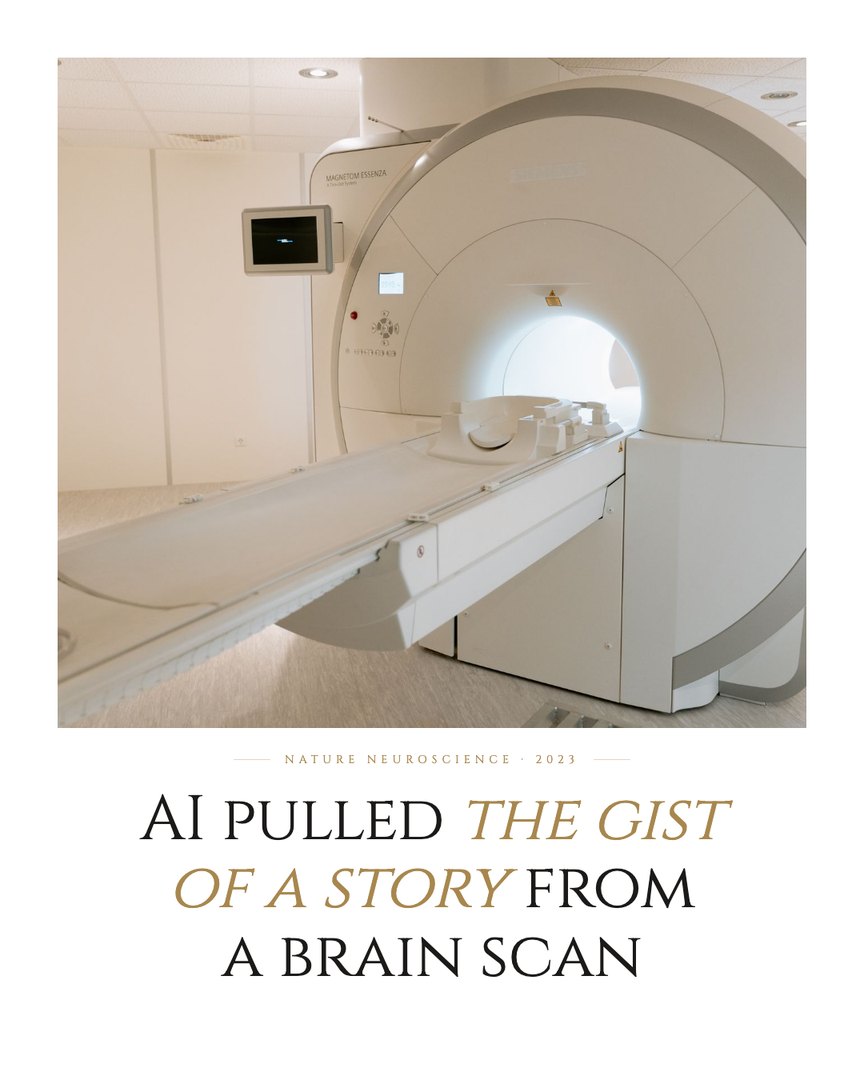
Researchers at the University of Texas at Austin built a decoder that reconstructed the gist of stories from one person's brain activity on an MRI scanner, whether the person was hearing, imagining, or silently watching them, using patterns borrowed from a large language model.
Shown only new brain scans, the decoder generated word sequences that captured the gist, not the exact wording, of stories the person had never heard during training. It worked across heard speech, imagined speech, and even silent video the person was simply watching, from one trained decoder per person.
The system needs a person's willing cooperation and roughly 16 hours of their own scanner data to train on; it cannot be pointed at someone else's brain and made to work, which the researchers presented as evidence the method respects mental privacy rather than threatening it. Moving this technology out of the MRI scanner and into something portable remains an open engineering problem.
Read the original study
Tang et al., Nature Neuroscience, 2023 · doi.org/10.1038/s41593-023-01304-9
A scan gave up a sentence never spoken.
Source
- Tang, J., LeBel, A., Jain, S., & Huth, A. G. (2023). Semantic reconstruction of continuous language from non-invasive brain recordings. Nature Neuroscience, 26(5), 858–866. https://doi.org/10.1038/s41593-023-01304-9