
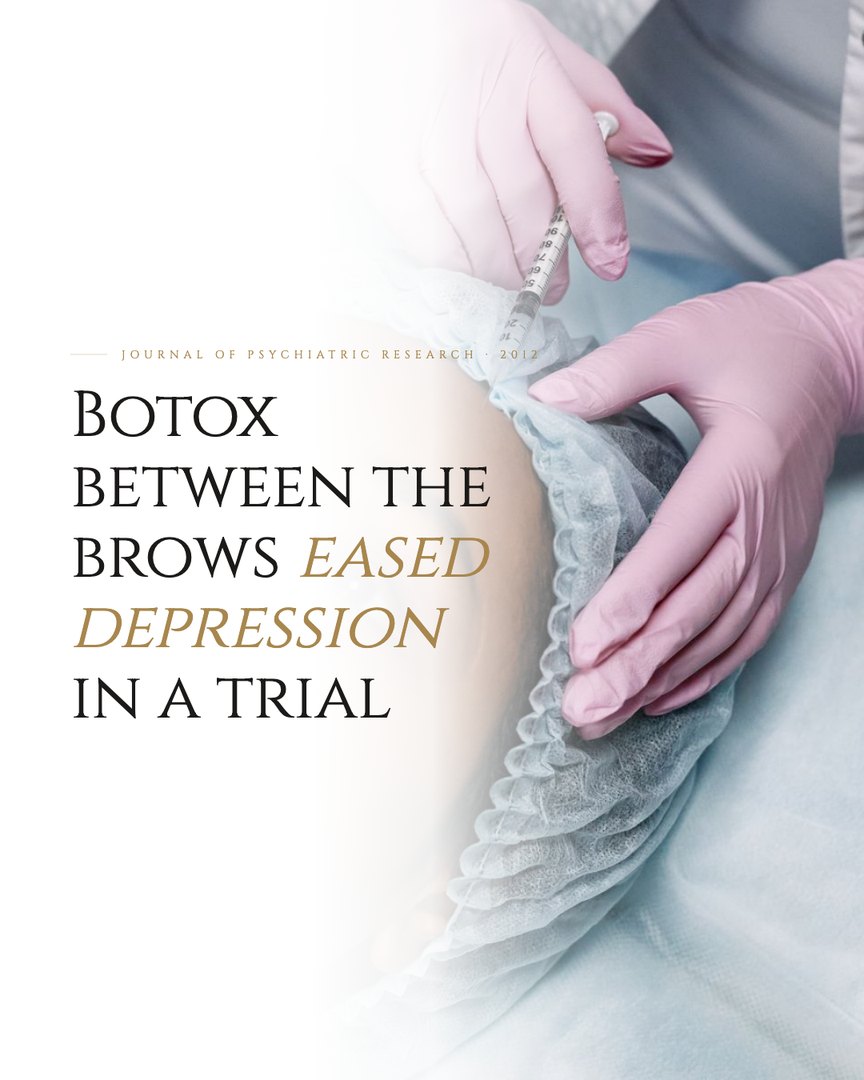
Researchers at the University of Basel tested that observation directly, giving a single botulinum toxin injection to the muscles between the eyebrows, the ones that pull into a frown, in people with depression who were still on their usual treatment.
In the 30-person trial, depression scores fell by about 47 percent six weeks after the injection, compared with about 9 percent on a placebo injection, and the gap widened further by the end of the study.
The idea, called facial feedback, holds that frowning is not just an expression of low mood but part of what sustains it, so paralyzing the muscle may interrupt a loop running from face to brain. The trial was small and used one type of botulinum toxin at one dose, and larger trials since have shown mixed results, so it has not become a standard depression treatment.
Read the original study
Wollmer et al., Journal of Psychiatric Research, 2012 · doi.org/10.1016/j.jpsychires.2012.01.027
A frown, unplugged from the mood.
Source
- Wollmer, M. A., de Boer, C., Kalak, N., Beck, J., Götz, T., Schmidt, T., Hodzic, M., Bayer, U., Kollmann, T., Kollewe, K., Sönmez, D., Duntsch, K., Haug, M. D., Schedlowski, M., Hatzinger, M., Dressler, D., Brand, S., Holsboer-Trachsler, E., & Kruger, T. H. C. (2012). Facing depression with botulinum toxin: a randomized controlled trial. Journal of Psychiatric Research, 46(5), 574–81. https://doi.org/10.1016/j.jpsychires.2012.01.027