
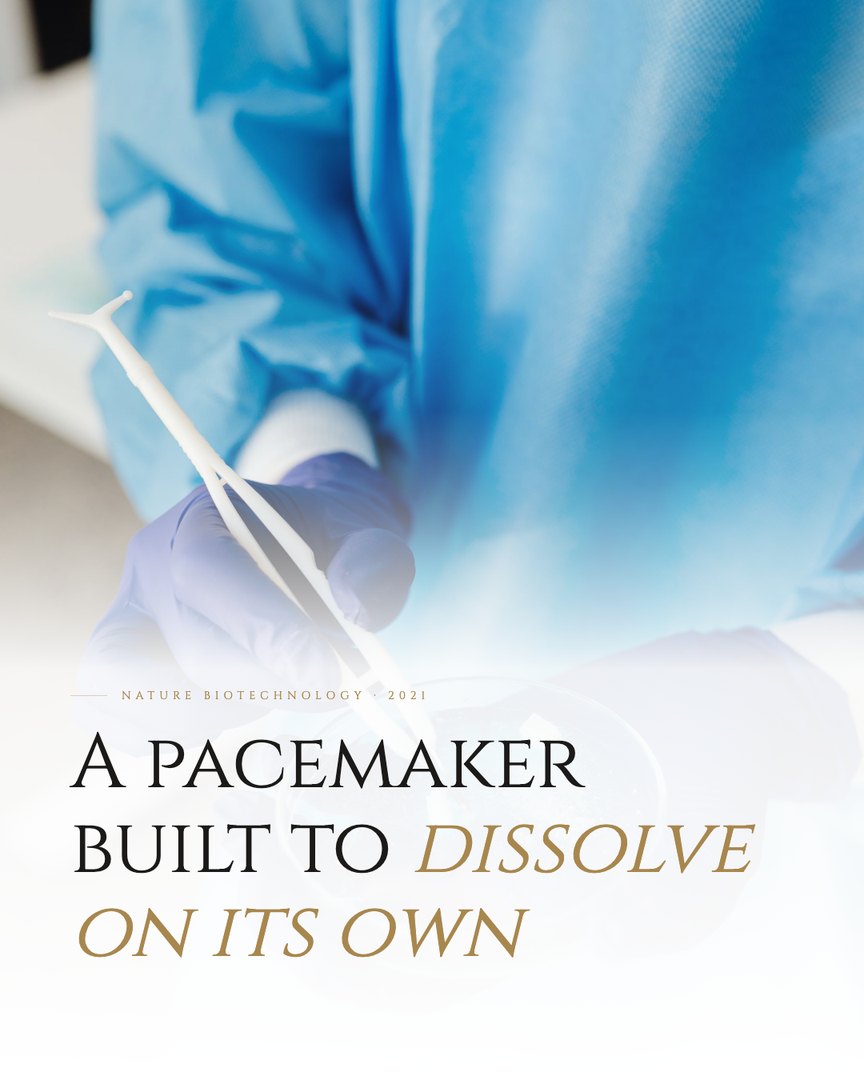
In 2021, engineers at Northwestern University and George Washington University built a pacemaker with no wires, no battery, and no permanent parts, designed to pace a heart for as long as needed and then dissolve harmlessly in the body.
The team tested the device in mice, rats, rabbits, and dogs, where it paced the heart wirelessly using a small skin-mounted patch for power, then broke down into harmless compounds over several weeks as designed. They also tested the device on donated human hearts to confirm it could pace tissue at human scale.
Because the device has no batteries or rigid electronics to fail or infect, it could reduce the surgery needed to remove a temporary pacemaker and lower complication rates after cardiac surgery. The design has not yet been tested in a living person, so a human implant trial, with full safety review, remains the next and largest step before it could reach patients.
Read the original study
Choi et al., Nature Biotechnology, 2021 · doi.org/10.1038/s41587-021-00948-x
Built to work, then disappear.
Source
- Choi, Y. S., Yin, R. T., Pfenniger, A., Koo, J., Avila, R., Benjamin Lee, K., Chen, S. W., Lee, G., Li, G., Qiao, Y., Murillo-Berlioz, A., Kiss, A., Han, S., Lee, S. M., Li, C., Xie, Z., Chen, Y.-Y., Burrell, A., Geist, B., . . . Rogers, J. A. (2021). Fully implantable and bioresorbable cardiac pacemakers without leads or batteries. Nature Biotechnology, 39(10), 1228–1238. https://doi.org/10.1038/s41587-021-00948-x