
Engineers at the MIT Center for Bionics built a neural interface that surgically reconnects a pair of muscles in the residual limb so they still stretch and signal each other the way they would in an intact leg, giving the brain real-time feedback about the prosthetic's position.
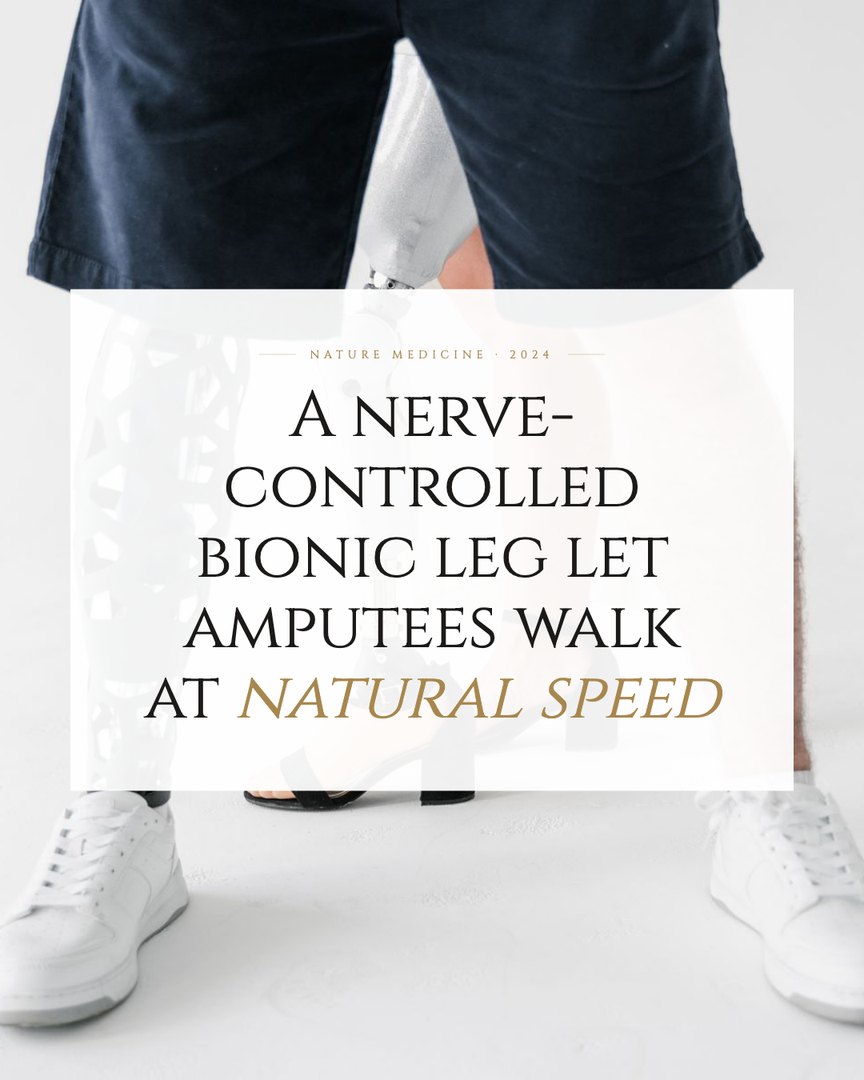
Across seven leg amputees fitted with the interface, the reconnected muscles restored about 18 percent of the sensory signal seen in an intact limb. That signal was enough to raise the amputees' maximum walking speed by 41 percent compared with a matched group without it, bringing their peak speed in line with people who had not had an amputation.
The restored signal also let the prosthetic adapt automatically to slopes, stairs, and obstructed paths. The gain came from a surprisingly small restoration of sensory feedback, suggesting the nervous system needs less information than expected to produce natural movement if it is the right kind of information. The study involved seven participants using one surgical interface, and whether the same gains hold more broadly is still being tested.
Read the original study
Song et al., Nature Medicine, 2024 · doi.org/10.1038/s41591-024-02994-9
A sliver of feedback, a full stride back.
Source
- Song, H., Hsieh, T.-H., Yeon, S. H., Shu, T., Nawrot, M., Landis, C. F., Friedman, G. N., Israel, E. A., Gutierrez-Arango, S., Carty, M. J., Freed, L. E., & Herr, H. M. (2024). Continuous neural control of a bionic limb restores biomimetic gait after amputation. Nature Medicine, 30(7), 2010–2019. https://doi.org/10.1038/s41591-024-02994-9