
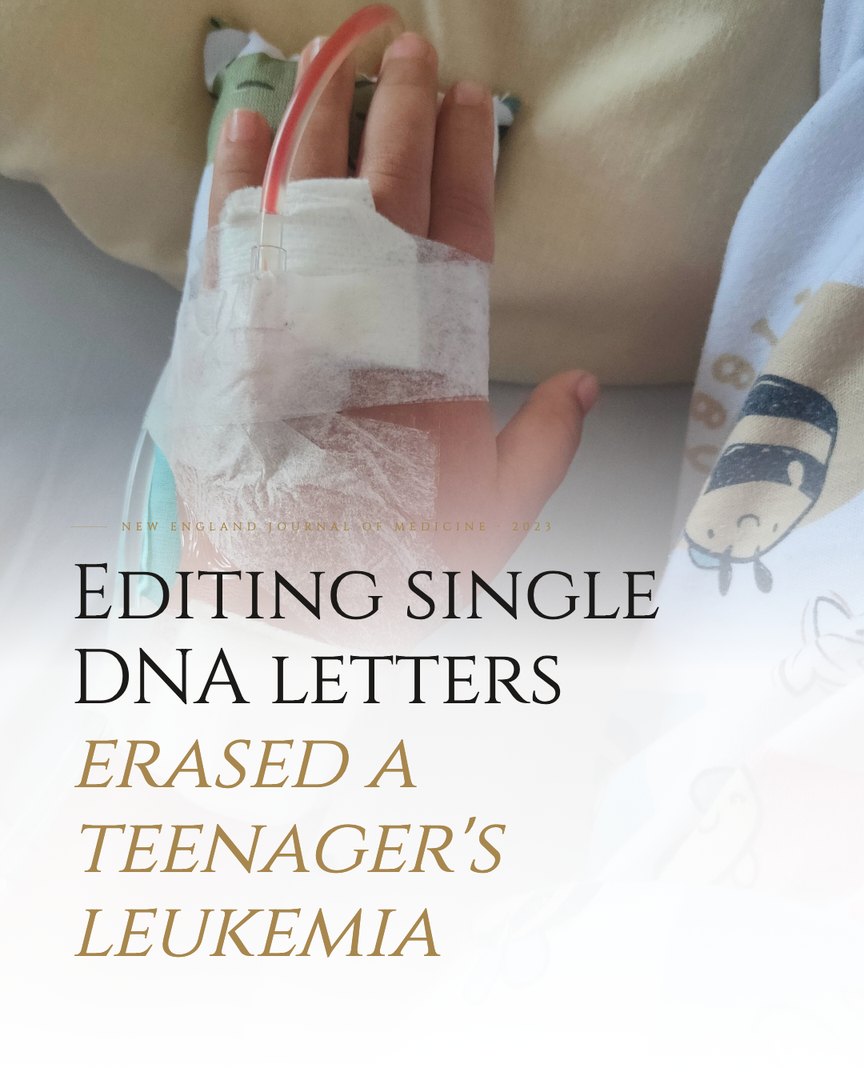
Doctors at Great Ormond Street Hospital in London turned to an experimental therapy never used in a person before: donor immune cells with their DNA edited letter by letter so they would attack the cancer without attacking each other.
Researchers used base editing to change four genes in donor T cells, stripping markers that would let the cells be rejected or kill each other, then infused the engineered CAR7 cells into the girl in December 2022. Within a month her bone marrow showed no detectable leukemia.
A bone marrow transplant followed soon after to consolidate the remission, since the edited cells were not expected to last in her body indefinitely. She remained free of leukemia in follow-up reporting, but she is the only patient treated this way so far, and doctors are watching to see whether the approach works as well in others before calling it a cure.
Read the original study
Chiesa et al., New England Journal of Medicine, 2023 · doi.org/10.1056/NEJMoa2300709
One patient, four edited genes, one remission.
Source
- Chiesa, R., Georgiadis, C., Syed, F., Zhan, H., Etuk, A., Gkazi, S. A., Preece, R., Ottaviano, G., Braybrook, T., Chu, J., Kubat, A., Adams, S., Thomas, R., Gilmour, K., O’Connor, D., Vora, A., & Qasim, W. (2023). Base-Edited CAR7 T Cells for Relapsed T-Cell Acute Lymphoblastic Leukemia. New England Journal of Medicine, 389(10), 899–910. https://doi.org/10.1056/NEJMoa2300709