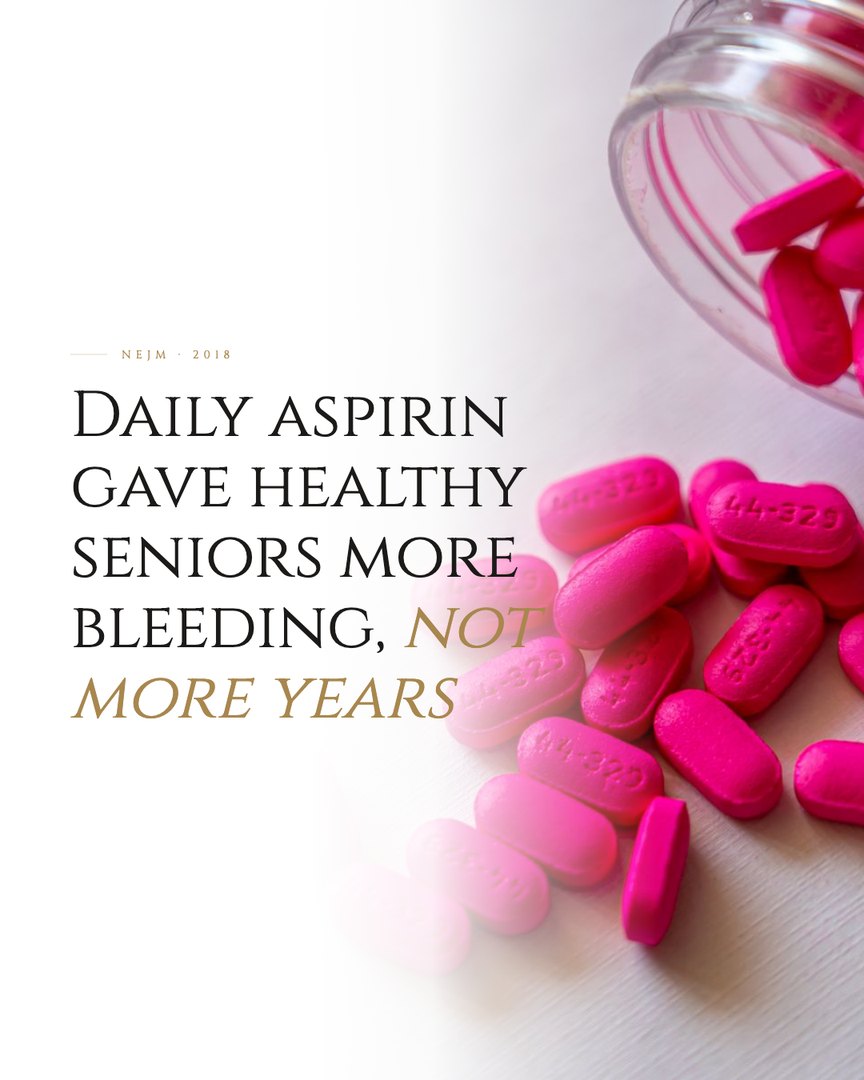
A Monash University-led team in Australia and the US ran a trial of 19,114 people aged 70 or older, or 65 or older in some US groups, giving half daily aspirin and half a placebo, then tracked whether the pill extended healthy, disability-free life.
Daily aspirin did not reduce death, disability, or dementia in this healthy older population, and the aspirin group had a higher rate of major bleeding, including in the brain and digestive tract. Deaths ran slightly higher on aspirin, mainly from cancer, a result the authors said to read with caution.
The result reversed decades of informal guidance that otherwise healthy older adults should take daily aspirin as a precaution, and guidelines now advise against starting daily aspirin for prevention in older adults without cardiovascular disease. The findings applied specifically to people without a prior heart attack or stroke; the calculation remains different for people who already have one.
Read the original study
Insurance that only paid in bleeding.
Source
- McNeil, J. J., Woods, R. L., Nelson, M. R., Reid, C. M., Kirpach, B., Wolfe, R., Storey, E., Shah, R. C., Lockery, J. E., Tonkin, A. M., Newman, A. B., Williamson, J. D., Margolis, K. L., Ernst, M. E., Abhayaratna, W. P., Stocks, N., Fitzgerald, S. M., Orchard, S. G., Trevaks, R. E., . . . Murray, A. M. (2018). Effect of Aspirin on Disability-free Survival in the Healthy Elderly. New England Journal of Medicine, 379(16), 1499–1508. https://doi.org/10.1056/nejmoa1800722