
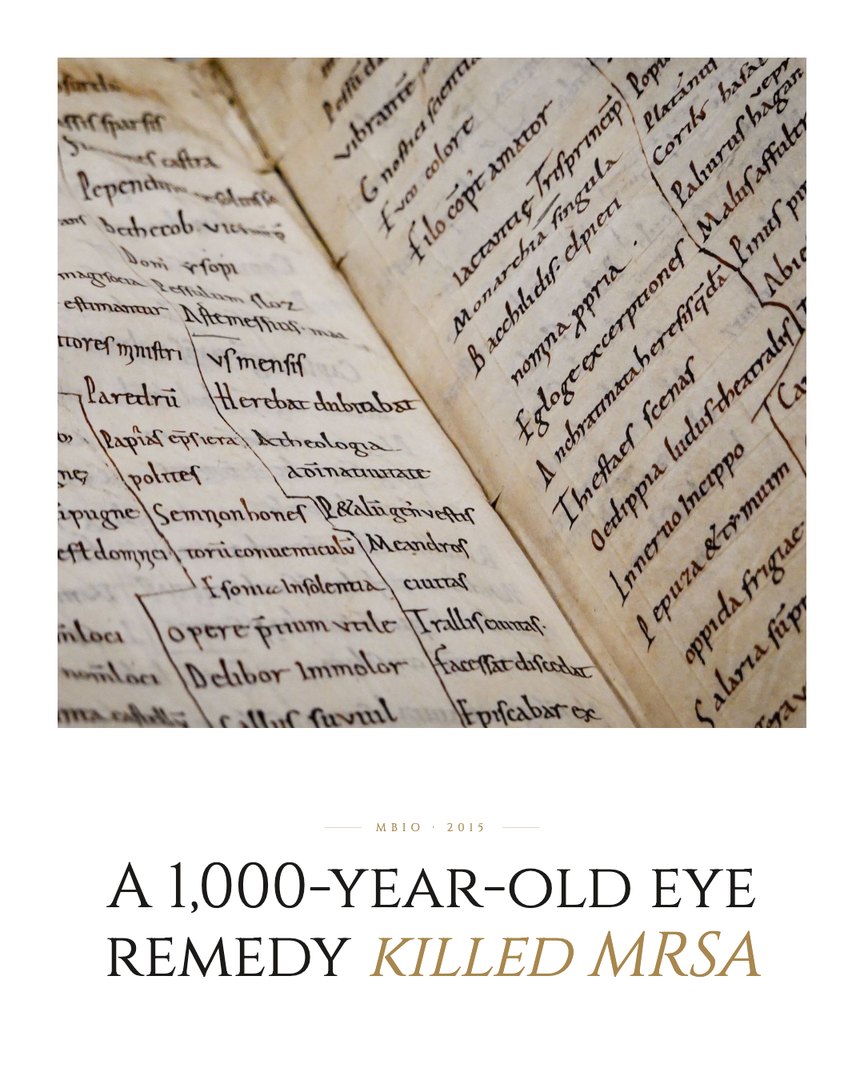
Researchers at the University of Nottingham and Texas Tech University reconstructed a 10th-century Anglo-Saxon remedy for eye infections, found in a manuscript called Bald's Leechbook, made from garlic, onion or leek, wine and cattle bile, then tested it against modern drug-resistant bacteria.
The reconstructed remedy repeatedly killed established Staphylococcus aureus biofilms in a laboratory model of soft tissue infection, and killed methicillin-resistant S. aureus, MRSA, in a mouse model of a chronic wound. Testing the ingredients separately showed each had only modest antibacterial activity alone; the full effect needed all of them combined.
The remedy's requirement for several ingredients acting together may explain why some individual natural compounds that show antibacterial promise in isolated lab tests fail when tested alone in clinical trials. The result does not mean the recipe is ready for modern medical use; it shows a specific historical formula, tested as its authors intended, worked against a drug-resistant strain that did not exist when it was written.
Read the original study
A folk remedy outperformed what folklore implied it should.
Source
- Harrison, F., Roberts, A. E. L., Gabrilska, R., Rumbaugh, K. P., Lee, C., & Diggle, S. P. (2015). A 1,000-Year-Old Antimicrobial Remedy with Antistaphylococcal Activity. MBio, 6(4), e01129. https://doi.org/10.1128/mBio.01129-15