
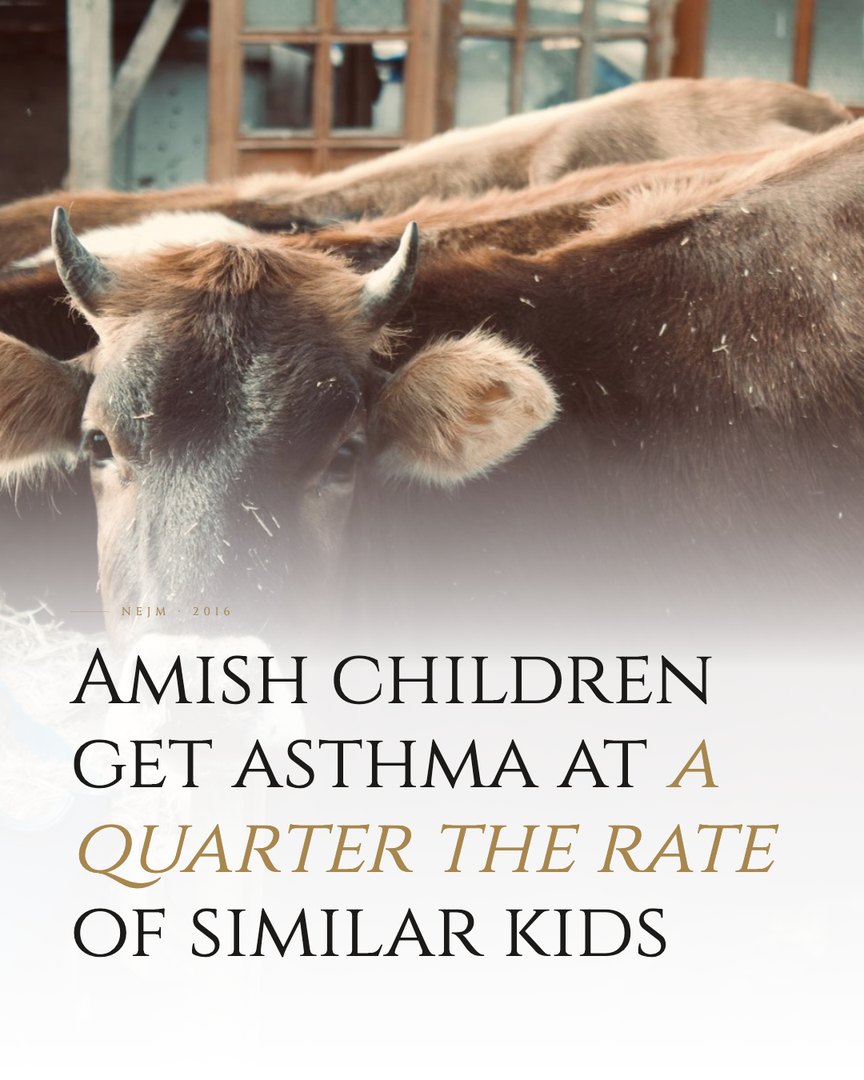
Researchers at the Universities of Chicago and Arizona compared Amish children in Indiana, who farm the traditional way with horses and open barns, to Hutterite children in South Dakota, who farm industrially. Genetically the two groups are closely related; their environments are not.
Earlier surveys found asthma in about 5 percent of Amish children and about 21 percent of Hutterite children, roughly a four-fold difference. Blood tests showed the Amish children's innate immune cells were primed differently, and when researchers gave mice dust collected inside Amish homes, it protected them from an asthma-like reaction to allergens, while Hutterite dust did not.
The dust itself, not genetics or diet, appeared to be shaping the children's immune systems before allergic disease could take hold. The finding fits a broader pattern seen in other farming populations with heavy early exposure to livestock and microbes, though researchers caution the Amish and Hutterite comparison is a single study of two specific communities, not yet proof that farm dust alone prevents asthma everywhere.
Read the original study
The dust was doing the protecting.
Source
- Stein, M. M., Hrusch, C. L., Gozdz, J., Igartua, C., Pivniouk, V., Murray, S. E., Ledford, J. G., Marques dos Santos, M., Anderson, R. L., Metwali, N., Neilson, J. W., Maier, R. M., Gilbert, J. A., Holbreich, M., Thorne, P. S., Martinez, F. D., von Mutius, E., Vercelli, D., Ober, C., & Sperling, A. I. (2016). Innate Immunity and Asthma Risk in Amish and Hutterite Farm Children. New England Journal of Medicine, 375(5), 411–421. https://doi.org/10.1056/nejmoa1508749