
Researchers at MIT trained two generative models to build molecules fragment by fragment rather than search for them. One target was drug-resistant gonorrhea; the other was MRSA, a hospital superbug resistant to most frontline drugs.
The models generated more than 36 million candidate molecules. Of 24 synthesized, seven killed bacteria selectively, and two lead compounds reduced infection in mice: one against drug-resistant gonorrhea, the other against MRSA skin infection. Both have structures unlike any antibiotic already in use.
Designing a molecule from nothing, rather than screening what already exists, opens a far larger search space than chemists could cover by hand. Both compounds are still early, tested only in mice, and years from a clinic. But a method that invents a structure rather than finds one changes how the next antibiotic search could start.
Read the original study
Krishnan et al., Cell, 2025 · doi.org/10.1016/j.cell.2025.07.033
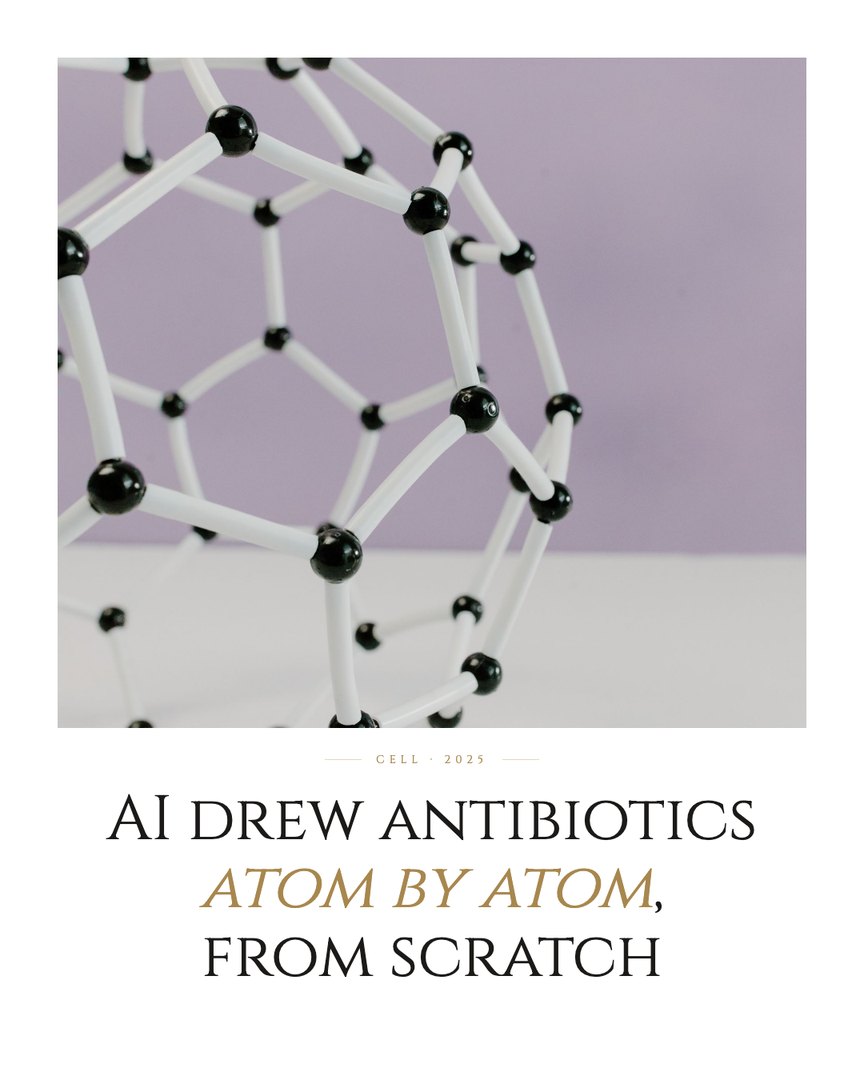
Drawn atom by atom by a machine, not found in nature.
Source
- Krishnan, A., Anahtar, M. N., Valeri, J. A., Jin, W., Donghia, N. M., Sieben, L., Luttens, A., Zhang, Y., Modaresi, S. M., Hennes, A., Fromer, J., Bandyopadhyay, P., Chen, J. C., Rehman, D., Desai, R., Edwards, P., Lach, R. S., Aschtgen, M.-S., Gaborieau, M., . . . Collins, J. J. (2025). A generative deep learning approach to de novo antibiotic design. Cell, 188(21), 5962–5979.e22. https://doi.org/10.1016/j.cell.2025.07.033