
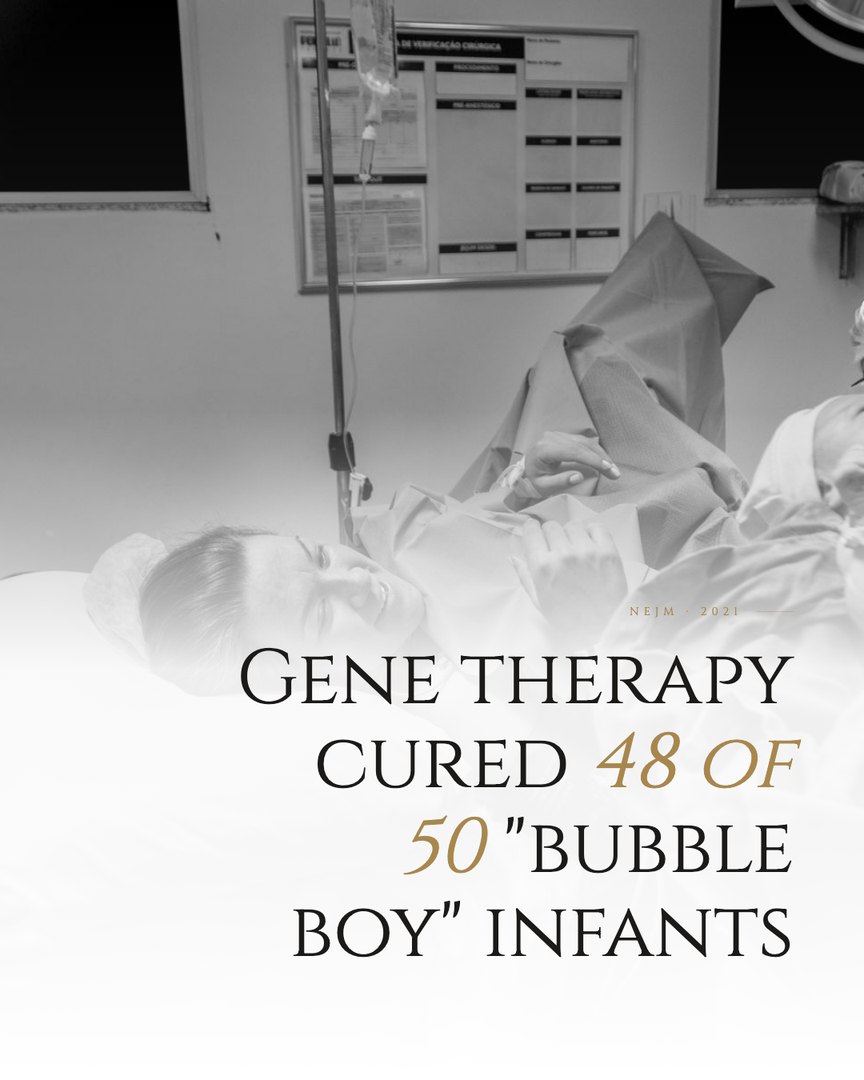
Researchers at UCLA treated 50 of these infants with a gene therapy built from their own cells, correcting the faulty gene in their own stem cells rather than relying on a donor's bone marrow.
Doctors removed each child's own blood stem cells, used an engineered virus to insert a working copy of the ADA gene, and returned the corrected cells to the child's body. Forty-eight of the 50 children were alive and had functioning immune systems at follow-up, off the enzyme injections and antibody infusions that had kept them going before.
Because the cells came from each child rather than a donor, there was no need for a matched sibling or a lifetime of immune-suppressing drugs to prevent rejection. The approach built on decades of earlier gene therapy attempts for the same disease that had produced weaker or shorter-lived results, and longer follow-up is still tracking how durable the correction remains.
Read the original study
Their own cells became the cure.
Source
- Kohn, D. B., Booth, C., Shaw, K. L., Xu-Bayford, J., Garabedian, E., Trevisan, V., Carbonaro-Sarracino, D. A., Soni, K., Terrazas, D., Snell, K., Ikeda, A., Leon-Rico, D., Moore, T. B., Buckland, K. F., Shah, A. J., Gilmour, K. C., De Oliveira, S., Rivat, C., Crooks, G. M., . . . Gaspar, H. B. (2021). Autologous Ex Vivo Lentiviral Gene Therapy for Adenosine Deaminase Deficiency. New England Journal of Medicine, 384(21), 2002–2013. https://doi.org/10.1056/NEJMoa2027675