
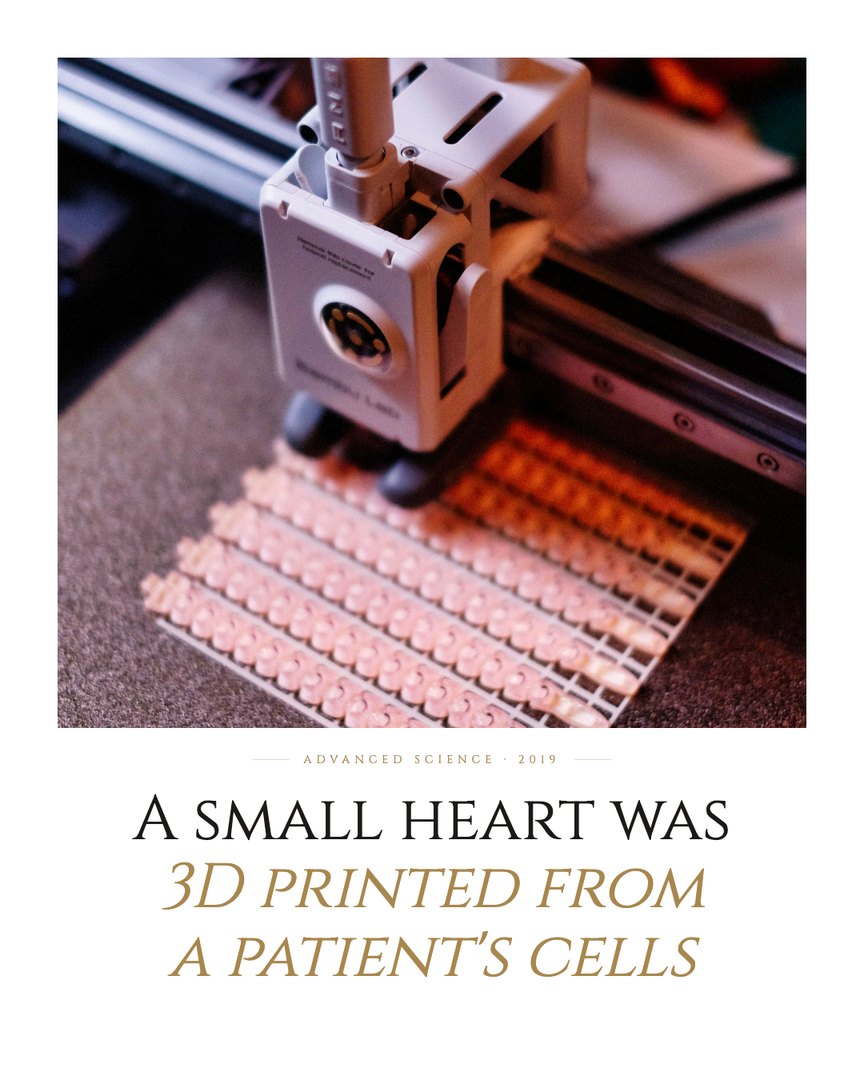
Researchers at Tel Aviv University took a small sample of fat tissue from a patient, reprogrammed its cells into heart muscle and blood vessel cells, and used them, along with a gel made from the same patient's own tissue, as the ink for a 3D printer.
The printer built a heart about 2 centimeters tall, with hollow chambers and major blood vessels, something earlier cardiac printing attempts had not managed. Thinner patches printed from the same patient-matched inks carried perfusable vessels and contracted in the lab.
The structure was not implanted in a person and is far smaller than a human heart, so this is a proof of concept rather than a transplant-ready organ. The patient-specific hydrogel is designed to avoid the immune rejection that complicates other engineered-tissue approaches. Scaling the method up to a full-sized, surgically useful human heart remains the unsolved next step.
Read the original study
Noor et al., Advanced Science, 2019 · doi.org/10.1002/advs.201900344
A person's own fat became a printed model heart.
Source
- Noor, N., Shapira, A., Edri, R., Gal, I., Wertheim, L., & Dvir, T. (2019). 3D Printing of Personalized Thick and Perfusable Cardiac Patches and Hearts. Advanced Science, 6(11), 1900344. https://doi.org/10.1002/advs.201900344